
Artificial Intelligence (AI) is no longer a futuristic concept—it's becoming an essential part of modern business. From intelligent chatbots and predictive analytics to automated workflows and personalized customer experiences, organizations across every industry are exploring AI to improve efficiency and drive innovation.
However, many businesses make one critical mistake.
They invest in AI tools before ensuring their data is ready.
The truth is simple:
AI success doesn't begin with choosing the right AI platform—it begins with building the right data foundation.
If your business data is inaccurate, inconsistent, or scattered across multiple systems, even the most advanced AI solutions will struggle to deliver meaningful results.
In this article, we'll explore what AI readiness really means, why data is the foundation of successful AI adoption, and how businesses can prepare for the future.
What Does AI-Ready Mean?
Being AI-ready doesn't simply mean purchasing an AI solution or integrating ChatGPT into your workflow.
An AI-ready business has:
• High-quality data
• Standardized business processes
• Connected systems
• Clear data ownership
• Strong data governance
• Reliable security and compliance
• A scalable technology infrastructure
AI performs best when it receives clean, structured, and trusted information.
Without these foundations, businesses risk wasting time, money, and resources.
Why Data Is the Foundation of AI
AI learns from data.
Every prediction, recommendation, automation, or insight generated by AI depends on the information it receives.
Think of AI as an experienced financial advisor.
Even the best advisor cannot provide accurate recommendations using incorrect financial records.
Similarly, AI cannot deliver reliable results when business data is incomplete or inconsistent.
This is why successful AI projects always begin with data quality.
Signs Your Business Is Not AI-Ready
Many organizations believe they are ready for AI when, in reality, they still face significant data challenges.
Here are some common warning signs.
1. Your Data Is Stored in Multiple Systems
Information is spread across:
• ERP
• CRM
• Excel spreadsheets
• Supplier portals
• E-commerce platforms
• Legacy applications
Without integration, AI receives fragmented information.
2. Duplicate Records Exist Everywhere
Duplicate customer, supplier, or product records reduce AI accuracy and increase operational complexity.
3. Product Information Is Incomplete
Missing product descriptions, specifications, images, or categories prevent AI from generating accurate recommendations and customer experiences.
4. Departments Use Different Naming Standards
When one department uses "Notebook" while another uses "Laptop," AI struggles to understand they represent the same product category.
Standardization matters.
5. Manual Data Entry Is Still Common
Manual processes increase errors, create inconsistencies, and slow digital transformation.
Automation becomes much easier when data is already standardized.
Why Businesses Fail with AI
Many AI initiatives fail because organizations focus on technology instead of data.
Common reasons include:
• Poor-quality data
• Missing business context
• No data governance
• Disconnected systems
• Lack of data ownership
• Inconsistent business processes
The problem isn't AI.
The problem is unreliable information.
What Makes Data AI-Ready?
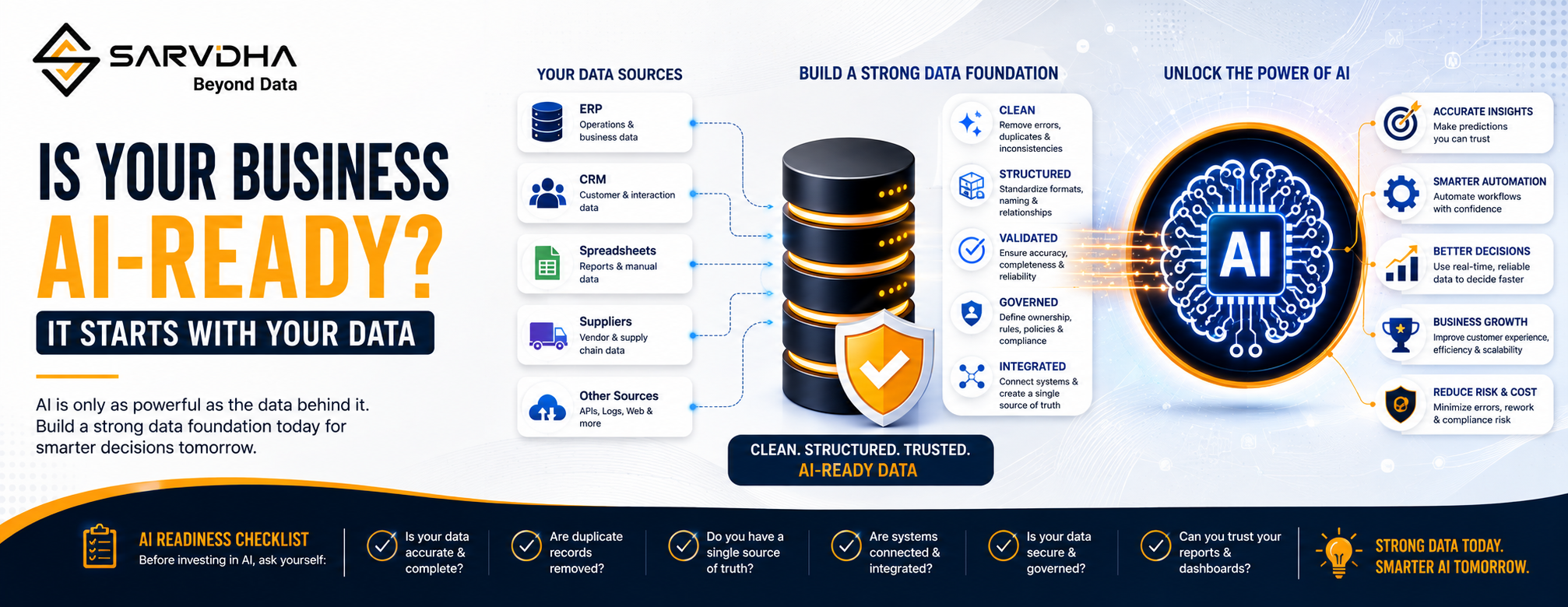
Before implementing AI, businesses should ensure their data is:
✓ Accurate
✓ Complete
✓ Consistent
✓ Structured
✓ Validated
✓ Up-to-date
✓ Secure
✓ Easy to access
When these characteristics exist, AI becomes significantly more effective.
Build a Single Source of Truth
One of the most important goals for AI readiness is creating a Single Source of Truth (SSOT).
Instead of maintaining multiple versions of the same information, businesses should centralize trusted data.
This creates consistency across departments and improves collaboration.
Examples include:
• Product Information Management (PIM)
• Master Data Management (MDM)
• Enterprise Resource Planning (ERP)
• Customer Relationship Management (CRM)
When systems work together, AI receives reliable information instead of conflicting records.
The Role of PIM and MDM
Businesses with large product catalogs or complex enterprise data often require specialized data management platforms.
A Product Information Management (PIM) system centralizes product information, improves data quality, and distributes consistent information across multiple channels.
A Master Data Management (MDM) solution manages critical business entities such as products, customers, suppliers, and locations.
Together, they provide the trusted data foundation required for AI.
AI Readiness Checklist
Before investing in AI, ask yourself:
✅ Is our data centralized?
✅ Is product information complete?
✅ Have duplicate records been removed?
✅ Do departments use standardized naming conventions?
✅ Can our systems exchange information automatically?
✅ Is our data regularly validated?
✅ Do we have clear ownership of business data?
✅ Can we trust our reports and dashboards?
If several answers are "No," improving your data should become your first priority.
Real Business Example
Imagine a retailer selling over 100,000 products through its website, Amazon, and multiple marketplaces.
Each department manages product information differently.
Marketing updates product descriptions.
Sales manages pricing.
Suppliers provide specifications.
Operations maintain inventory.
Without centralized product information, AI generates inconsistent descriptions, incorrect recommendations, and inaccurate reports.
After implementing a Product Information Management (PIM) solution and standardizing data, the retailer experiences:
• Faster product launches
• More accurate AI recommendations
• Improved customer experiences
• Reduced manual work
• Better reporting
The AI didn't improve.
The data did.
Benefits of Becoming AI-Ready
Organizations with strong data foundations can expect:
• Better AI accuracy
• Faster decision-making
• Improved customer experiences
• More reliable automation
• Increased productivity
• Higher operational efficiency
• Better collaboration
• Reduced business risk
AI becomes a competitive advantage when powered by trusted information.
How Sarvdha Helps Businesses Become AI-Ready
At Sarvdha, we help organizations build the strong data foundations required for successful AI adoption.
Our expertise includes:
• Product Information Management (PIM)
• Master Data Management (MDM)
• Data Modeling
• Data Integration
• Data Governance
• Digital Asset Management (DAM)
• Enterprise Application Development
• Custom Software Solutions
We believe that successful AI begins with reliable data, well-designed processes, and scalable technology.
Conclusion
AI is transforming industries faster than ever before.
But technology alone is not enough.
Organizations that invest in clean, structured, and trusted data today will be far better positioned to leverage AI tomorrow.
Before asking,
"Which AI solution should we implement?"
Ask,
"Is our business truly AI-ready?"
Because every successful AI journey starts with data.
Frequently Asked Questions
What does AI-ready mean?
An AI-ready business has clean, structured, secure, and accessible data supported by strong governance, integrated systems, and standardized business processes.
Why is data important for AI?
AI relies on data to learn, analyze, and generate insights. Better data leads to more accurate and reliable AI outcomes.
What is a Single Source of Truth (SSOT)?
A Single Source of Truth is a centralized and trusted location where business data is managed consistently and shared across departments.
How do PIM and MDM support AI?
PIM improves product data quality, while MDM manages core business data consistently. Together, they create a reliable foundation for AI-driven applications.
How can businesses prepare for AI?
Businesses should focus on improving data quality, integrating systems, standardizing information, implementing governance, and creating a Single Source of Truth before adopting AI technologies.
Need Help Building an AI-Ready Business?
Whether you're planning your first AI initiative or looking to improve your existing data foundation, Sarvdha can help you organize, manage, and optimize your enterprise data for long-term success.