
PIM vs ERP: What's the Difference and Why Growing E-commerce Businesses Need Both?
Many growing businesses eventually face a common question:
“We already have an ERP. Why do we need a PIM?”
It is a reasonable question.
ERP systems manage critical business operations such as inventory, purchasing, orders, finance, suppliers, warehousing, and other transactional processes.
PIM systems focus on something different:
Product information.
As an e-commerce business grows, product information becomes increasingly complex.
A business may need to manage thousands of products, hundreds of product attributes, product images and videos, technical specifications, marketing descriptions, multiple languages, multiple currencies, different countries, marketplaces, and multiple sales channels.
Trying to manage all of this inside an ERP can create unnecessary complexity.
This is where PIM and ERP can work together.
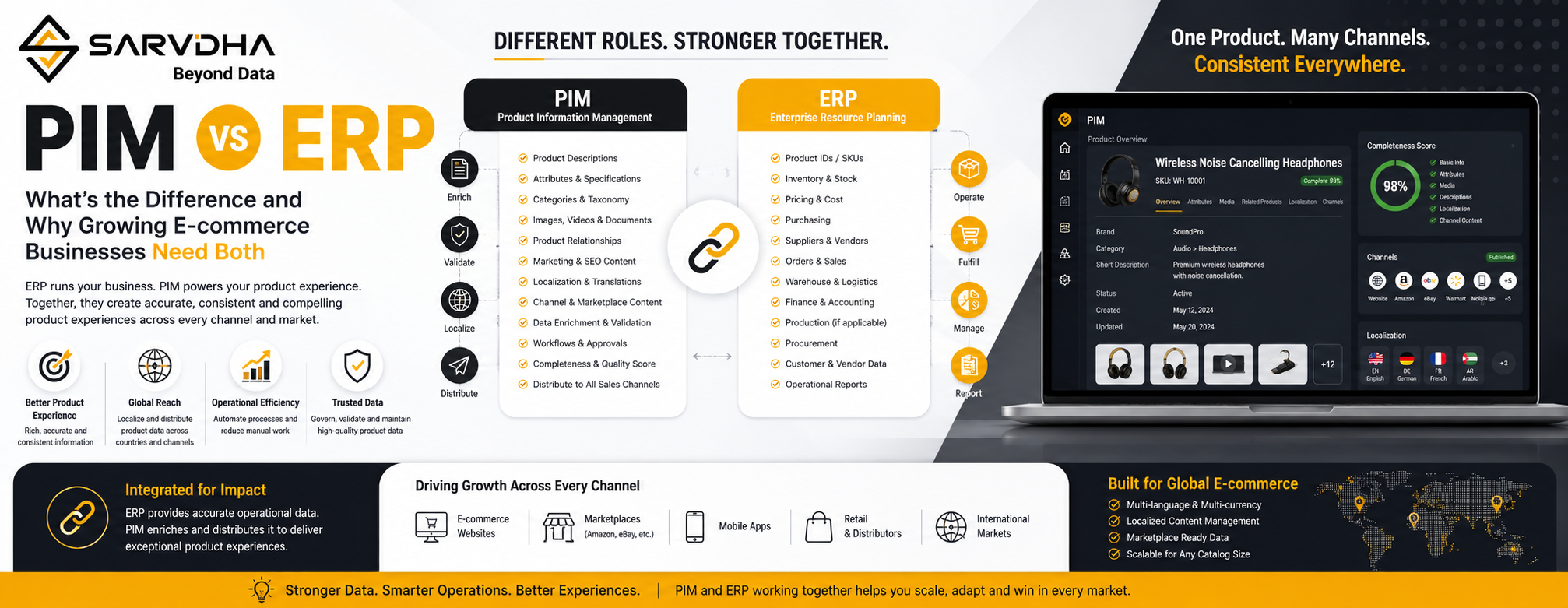
ERP manages the business operations.
PIM manages the product experience.
What Is an ERP?
ERP stands for Enterprise Resource Planning.
An ERP system connects and manages important business processes across an organization.
Depending on the business, an ERP may manage:
- Finance
- Purchasing
- Inventory
- Orders
- Suppliers
- Warehousing
- Manufacturing
- Logistics
- Pricing
- Customers
- Basic product information
For example, when a customer purchases a product, the ERP can help manage order processing, inventory, warehouse operations, shipping, invoicing, and financial records.
ERP is therefore primarily focused on running the business.
What Is PIM?
PIM stands for Product Information Management.
A PIM system is designed to manage, enrich, validate, govern, and distribute product information.
Product information can include:
- Product names
- Product descriptions
- Technical specifications
- Product attributes
- Categories
- Product relationships
- Marketing content
- SEO content
- Product images
- Product videos
- Product documents
- Translations
- Localized content
- Marketplace information
- Channel-specific information
PIM focuses on making product information:
Complete, accurate, consistent, enriched, localized, and ready for distribution.
PIM vs ERP: The Simple Difference
The easiest way to understand the difference is this:
ERP manages how your business operates.
PIM manages how your products are described, enriched, and presented across digital channels.
An ERP may know that a product has:
- SKU
- Price
- Stock
- Supplier
- Warehouse
- Cost
A PIM may manage:
- Product descriptions
- Product features
- Product specifications
- Marketing content
- Product attributes
- Categories
- Product relationships
- SEO content
- Translations
- Marketplace content
- Channel-specific information
Both are important, but they serve different purposes.
Why Can't an ERP Manage All Product Information?
Technically, an ERP can store product information.
The problem is that storing product information is not the same as managing product information for digital commerce.
Consider a product with:
- 100+ attributes
- 10 images
- Multiple videos
- Technical documents
- SEO content
- Marketing descriptions
- Multiple languages
- Country-specific information
- Marketplace-specific requirements
Now multiply that by 50,000 products.
Then add five countries and ten sales channels.
The complexity becomes significant.
This is where a dedicated PIM architecture can provide value.
ERP Product Data vs PIM Product Data
An ERP might contain information such as:
SKU: LAP-10001
Product Name: Laptop X
Price: $999
Stock: 250
Supplier: ABC
Warehouse: New York
This information is important for business operations.
But an e-commerce website may also need:
- Product name
- Short description
- Long description
- Technical specifications
- Features
- Benefits
- SEO title
- SEO description
- Search keywords
- Images
- Videos
- Documents
- Product relationships
- Compatible products
- Localized content
- Marketplace-specific content
The second set of information is much more focused on selling and presenting the product.
That is where PIM becomes useful.
How PIM and ERP Work Together
A strong enterprise architecture does not necessarily replace ERP with PIM.
Instead, the systems work together.
The ERP can provide operational information such as SKU, pricing, inventory, supplier information, and other business data.
The PIM can then enrich and manage the product information required for customer-facing experiences.
The resulting product information can be distributed to:
- E-commerce websites
- Mobile applications
- Marketplaces
- Retail partners
- Distributor portals
- Regional websites
- Other digital channels
This approach can reduce duplication and provide greater control over product information.
What Information Should Come From ERP?
ERP is generally a strong source for operational information.
Depending on the organization, this may include:
- SKU
- Product ID
- Inventory
- Stock availability
- Purchasing information
- Supplier information
- Base pricing
- Cost
- Order information
- Warehouse information
- Product status
The exact ownership should always be defined during enterprise architecture and data governance planning.
What Information Should Be Managed in PIM?
PIM is typically responsible for customer-facing product information.
This can include:
- Product descriptions
- Product attributes
- Product features
- Product benefits
- Product specifications
- Product taxonomy
- Product relationships
- Marketing content
- SEO content
- Translations
- Channel-specific content
- Marketplace attributes
- Product completeness
- Product enrichment
The exact split depends on the organization's architecture and business requirements.
What About DAM?
Another system that often works alongside PIM is DAM, or Digital Asset Management.
DAM focuses on digital assets such as:
- Product images
- Product videos
- PDFs
- Product manuals
- Marketing files
- Brand assets
- Technical documents
A typical enterprise environment may therefore contain ERP, PIM, DAM, MDM, e-commerce platforms, marketplaces, and other business applications.
Each system should have a clearly defined responsibility.
PIM manages product information.
DAM manages digital assets.
ERP manages operational processes.
MDM manages broader master data governance.
PIM vs ERP vs DAM vs MDM
It can be useful to think about these systems in simple terms.
ERP:
“How does the business operate?”
PIM:
“How do we manage and present our products?”
DAM:
“How do we manage our digital assets?”
MDM:
“How do we maintain trusted master data across the organization?”
These systems are not necessarily alternatives.
They can form different layers of a larger enterprise data architecture.
Example: A Global E-commerce Company
Imagine a company selling consumer electronics.
It has 30,000 products and operates across:
- United States
- United Kingdom
- Germany
- France
- UAE
It sells through:
- Its own website
- Amazon
- Regional marketplaces
- Mobile applications
- Retail distributors
The ERP manages information related to:
- SKU
- Inventory
- Pricing
- Suppliers
- Orders
- Purchasing
The PIM manages:
- Product descriptions
- Technical specifications
- Attributes
- Categories
- Product relationships
- SEO content
- Translations
- Marketplace content
The DAM manages:
- Product images
- Product videos
- Manuals
- Marketing assets
This creates a connected product data ecosystem.
What Happens Without PIM?
Without a dedicated product information layer, teams may start managing product content through:
- Excel
- Google Sheets
- ERP fields
- CMS platforms
- Marketplace portals
- Shared folders
This can create multiple versions of the same product.
For example, the product name might be different in the ERP, website, Amazon listing, and regional website.
Now the business has to determine:
Which version is correct?
This is a product data governance problem.
As the number of products and channels increases, these inconsistencies can become increasingly difficult to manage.
PIM Creates a Central Product Information Layer
With PIM, businesses can establish a controlled product information layer.
Product information can be collected from different sources, enriched inside the PIM, validated according to business rules, approved by the appropriate teams, and distributed to customer-facing channels.
This creates a more structured process:
Collect → Enrich → Validate → Approve → Publish
Instead of every channel independently maintaining product information, the organization can establish clear ownership and governance.
Why Data Ownership Matters
One of the biggest challenges in enterprise architecture is allowing multiple systems to become the source of truth for the same information.
For example:
Who owns the product name?
ERP?
PIM?
E-commerce platform?
Marketing system?
If multiple systems can independently modify the same field, synchronization becomes difficult.
A better approach is to define ownership.
For example:
SKU: ERP
Inventory: ERP
Cost: ERP
Product Description: PIM
Marketing Content: PIM
Product Attributes: PIM
Product Images: DAM
Customer Master Data: MDM or CRM
Orders: ERP
The exact ownership depends on the organization, but it should be clearly defined.
PIM and ERP Integration
The integration between PIM and ERP should be carefully designed.
For example, ERP may send product identifiers, basic information, pricing references, supplier information, and other operational data to PIM.
PIM may then enrich the information with descriptions, attributes, specifications, marketing content, localized information, and channel-specific content.
The final product information can then be distributed to e-commerce platforms, marketplaces, mobile applications, and other digital channels.
Depending on the architecture, some information may flow in both directions.
The most important thing is to define which system owns each type of data.
PIM and E-commerce Platforms
PIM can also act as an important layer between enterprise systems and e-commerce platforms.
Instead of every digital channel connecting directly to every internal system, PIM can provide standardized and channel-ready product information.
This can help businesses manage product information more consistently across:
- Websites
- Mobile applications
- Marketplaces
- Distributor portals
- Retail partner systems
- Regional e-commerce stores
For companies with complex digital commerce environments, this can simplify product information management significantly.
PIM for International E-commerce
The value of PIM becomes even greater when a company operates internationally.
A single product may need different information for different markets.
For example:
United States
USD, English, US-specific content
United Kingdom
GBP, English, UK-specific content
Germany
EUR, German, localized product information
France
EUR, French, localized product information
UAE
AED, localized regional content
The core product remains the same.
However, the customer-facing product experience can vary by market.
A properly designed PIM can help manage these variations without creating completely separate product records for every country.
PIM and AI
There is another reason PIM is becoming increasingly important:
Artificial Intelligence.
AI-powered commerce depends heavily on structured product information.
Imagine a customer asks:
“Show me lightweight waterproof jackets for hiking in cold weather.”
To provide a useful answer, an AI system needs to understand product information such as:
- Product category
- Weight
- Material
- Waterproof rating
- Temperature suitability
- Size
- Availability
- Product features
If the underlying product data is incomplete or inconsistent, the AI experience can suffer.
This is why:
Better product data → Better AI experiences.
PIM can provide the structured product information layer that AI applications can consume.
PIM and Product Search
Search is another important area.
Customers don't always search using the exact product name.
For example, a customer might search:
“Wireless headphones with noise cancellation.”
The product catalog might contain:
“Bluetooth ANC Headset.”
Structured attributes, synonyms, relationships, and product metadata can help search systems understand the relationship between these concepts.
Better product data can therefore support:
- Product discovery
- Search relevance
- Filtering
- Recommendations
- Personalization
- Conversion
PIM and SEO
Product information also plays an important role in e-commerce SEO.
Search engines need to understand information such as:
- Product name
- Product description
- Brand
- Category
- Specifications
- Availability
- Price
- Product relationships
A well-managed PIM can help businesses maintain consistent product content across their digital channels.
However, PIM by itself does not automatically improve SEO.
SEO performance also depends on:
- Website architecture
- Technical SEO
- Content quality
- Structured data
- Internal linking
- Page performance
- Search intent
- Overall content strategy
PIM simply provides a stronger foundation for managing product information at scale.
When Should You Add PIM to Your Architecture?
PIM may be worth considering when your organization has several of the following challenges:
- Large product catalog
- Multiple product categories
- Multiple countries
- Multiple languages
- Multiple sales channels
- Complex product attributes
- Frequent product updates
- Marketplace distribution
- Supplier product feeds
- Spreadsheet-based product management
- Poor product data quality
- Slow product onboarding
- Inconsistent product information
- AI-powered commerce plans
If several of these apply to your business, a dedicated product information layer may provide significant value.
When Might You Not Need PIM?
Not every business needs an enterprise PIM system.
If you have:
- A small product catalog
- One market
- One sales channel
- Simple product information
- Very few product updates
then implementing an enterprise PIM may create unnecessary complexity.
The right architecture depends on your actual business requirements.
PIM should solve a real business problem.
It should not be implemented simply because it is a popular technology.
How to Decide Between ERP-Only and ERP + PIM
Ask your organization these questions:
How many products do we manage?
The larger the catalog, the more difficult manual product management becomes.
How many attributes does each product have?
Highly configurable or technical products can require hundreds of attributes.
How many countries do we sell in?
International operations increase localization requirements.
How many languages do we support?
Multiple languages require structured localization processes.
How many sales channels do we use?
Each additional channel can introduce new product data requirements.
How often does product information change?
Frequent updates increase the importance of centralized management.
How much product data is maintained manually?
Heavy spreadsheet usage is often a sign that the current process is difficult to scale.
How many teams manage product information?
Multiple teams require stronger workflows and governance.
Do we need marketplace syndication?
Marketplaces often have their own product information requirements.
Are we planning AI-powered product search or recommendations?
If yes, structured and consistent product data becomes even more important.
The more complex the answers become, the stronger the potential case for a dedicated PIM layer.
Common PIM and ERP Mistakes
Mistake 1: Treating ERP as the Only Source for Everything
ERP is extremely important, but it is not necessarily designed to manage every aspect of customer-facing product content.
Mistake 2: Creating Product Data Directly in Every Channel
Creating product information separately in websites, marketplaces, mobile applications, and other channels creates duplication.
It also makes governance difficult.
Mistake 3: Allowing Multiple Sources of Truth
Every important data field should have clearly defined ownership.
Mistake 4: Ignoring Product Data Governance
Technology alone does not solve data quality problems.
People, processes, governance, and technology all need to work together.
Mistake 5: Implementing PIM Without a Data Model
A poorly designed product model can create long-term problems even when the PIM platform itself is powerful.
Mistake 6: Migrating Poor-Quality Data
Moving bad data from an ERP or spreadsheet into a PIM does not solve the problem.
It simply moves the problem into a new system.
Data should be audited, cleaned, standardized, and validated before large-scale migration.
PIM, ERP and the Future of Digital Commerce
The future of enterprise commerce is not about choosing one system.
It is about connecting the right systems.
ERP provides operational information.
PIM provides structured product information.
DAM provides digital assets.
MDM provides broader master-data governance.
AI consumes trusted information and creates new digital experiences.
Together, these technologies can create a powerful digital commerce ecosystem.
For global businesses, this becomes even more important as they expand into new markets and channels.
How Sarvdha Can Help
At Sarvdha, we help businesses design scalable product and enterprise data architectures.
Our services include:
- PIM architecture
- PIM implementation
- ERP-PIM integration
- Product data modeling
- Taxonomy design
- Product data migration
- Data governance
- MDM solutions
- DAM integration
- E-commerce integration
- Marketplace integration
- Global product localization
- AI-ready product data
We focus on understanding the business requirements first and then designing the right architecture around them.
Because the goal isn't to add another system.
The goal is to make your systems work together.
Conclusion
PIM and ERP are not competing technologies.
They solve different business problems.
ERP helps businesses manage their operations.
PIM helps businesses manage and distribute rich product information.
As companies expand across countries, channels, marketplaces, and digital experiences, product information becomes increasingly complex.
Trying to manage everything inside an ERP—or maintaining product information separately in spreadsheets and digital channels—can eventually create data quality, operational, and scalability problems.
A well-designed architecture can instead connect:
ERP + PIM + DAM + MDM + E-commerce + AI
Each system performs the job it is best suited for.
The result can be:
Better product experiences.
Better data quality.
Faster product launches.
Better digital commerce.
Scalable global growth.
The real question isn't:
“PIM or ERP?”
It's:
“How should PIM and ERP work together to support our business?”
Frequently Asked Questions
Is PIM better than ERP?
Neither is universally better. ERP and PIM serve different purposes. ERP manages business operations, while PIM focuses on product information and its distribution to customer-facing channels.
Can PIM replace ERP?
No. PIM generally complements ERP rather than replacing it.
Can ERP replace PIM?
For small catalogs and simple businesses, ERP may be sufficient. As product information becomes more complex, a dedicated PIM can provide specialized capabilities for product enrichment, governance, localization, and distribution.
Does PIM integrate with ERP?
Yes. ERP-PIM integration is a common enterprise architecture pattern. The exact data flows depend on which system owns each type of information.
What is the difference between PIM and MDM?
PIM focuses primarily on product information used for commerce and digital experiences. MDM provides broader master-data governance across areas such as products, customers, suppliers, and other business entities.
What is the difference between PIM and DAM?
PIM manages product information. DAM manages digital assets such as images, videos, documents, and other media.
Does PIM improve e-commerce?
PIM can help improve product data consistency, completeness, localization, channel distribution, and product discovery. The actual business impact depends on implementation and data quality.
Is PIM useful for AI?
Yes. Structured, consistent, and governed product information can provide a stronger foundation for AI-powered search, recommendations, content generation, and conversational commerce.