
PIM Implementation Cost in 2026: What Does a PIM Project Really Cost?
If your business is considering a Product Information Management (PIM) system, one of the first questions you will probably ask is:
“How much does PIM implementation cost?”
There is no single answer.
A PIM project can cost significantly different amounts depending on the size of your product catalog, data complexity, number of markets, integrations, workflows, users, migration requirements, and level of customization.
A small business with a few thousand products and one sales channel has very different requirements from a global enterprise managing hundreds of thousands of products across multiple countries and marketplaces.
The software license is also only one part of the total investment.
A successful PIM project can involve:
- PIM software
- Solution architecture
- Product data modeling
- Data cleansing
- Data migration
- ERP integration
- DAM integration
- E-commerce integration
- Marketplace integration
- Workflow configuration
- Localization
- Custom development
- Testing
- Training
- Support
- Ongoing maintenance
Understanding these costs before starting the project can help businesses build a realistic PIM budget and avoid unexpected expenses.
What Is PIM Implementation?
PIM implementation is the process of introducing a Product Information Management system into an organization's technology and business environment.
It is not simply installing software.
A typical implementation may involve:
Strategy → Data Modeling → Configuration → Integration → Migration → Testing → Training → Go-Live → Optimization
The exact process depends on the organization's requirements.
For a simple implementation, the process may be relatively straightforward.
For a global enterprise, PIM implementation can become a large transformation project involving multiple teams, systems, countries, and business processes.
Why PIM Implementation Costs Vary
Two businesses can use the same PIM platform and still have completely different implementation costs.
Consider these two examples.
Business A
A company has:
- 5,000 products
- One country
- One language
- One e-commerce website
- Simple product attributes
- One ERP
- No marketplace integrations
The implementation may be relatively simple.
Business B
Another company has:
- 250,000 products
- Multiple brands
- Multiple countries
- Multiple languages
- Complex product variants
- Multiple ERP systems
- DAM
- E-commerce platforms
- Marketplaces
- Regional websites
- Complex approval workflows
- Supplier data feeds
The second project requires significantly more architecture, integration, migration, governance, and testing.
This is why asking only:
“How much does a PIM cost?”
is not enough.
You need to understand:
“How complex is our PIM implementation?”
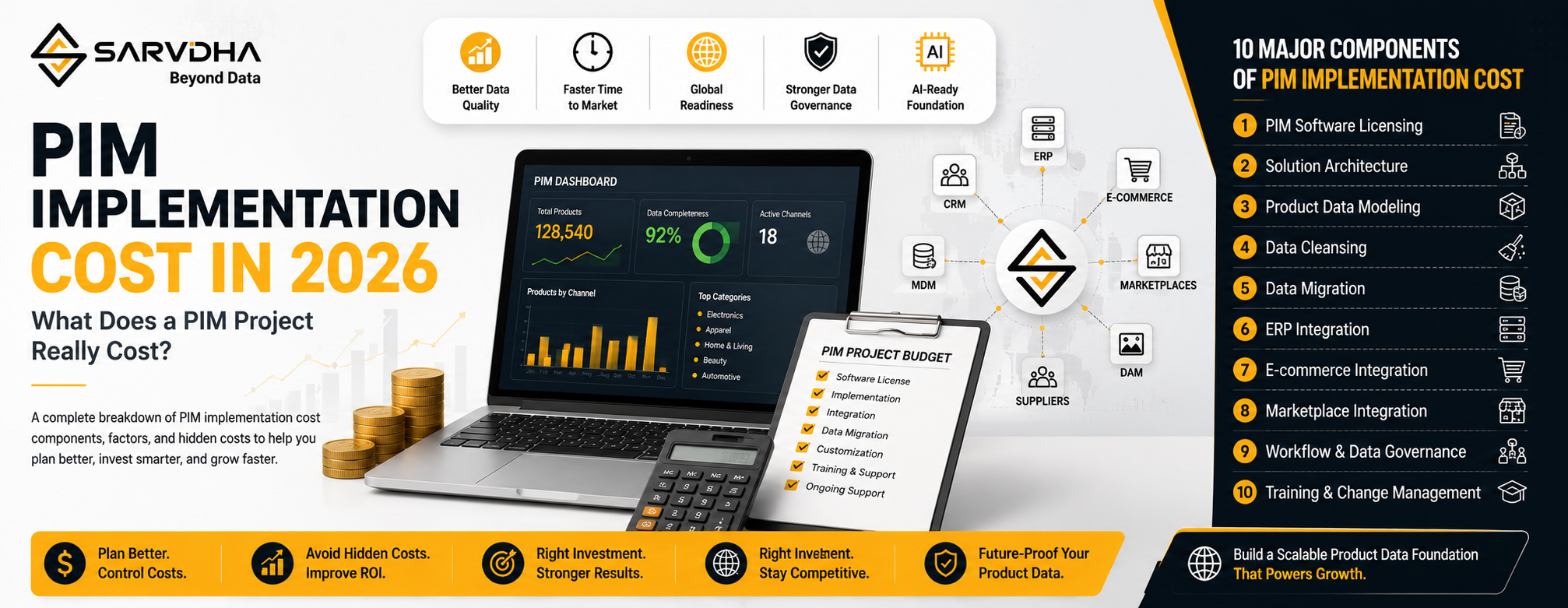
The 10 Major Components of PIM Implementation Cost
1. PIM Software Licensing
The first cost is the PIM platform itself.
Depending on the vendor, pricing may be based on:
- Number of users
- Number of products
- Data volume
- API usage
- Environments
- Modules
- Channels
- Features
- Hosting model
Some platforms use subscription-based pricing.
Others may have different licensing structures.
When comparing PIM platforms, don't compare only the initial subscription.
Look at the expected cost over several years.
2. Solution Architecture
Before implementation begins, your organization needs to understand how PIM will fit into the existing technology landscape.
For example:
ERP → PIM → E-commerce
But your actual architecture might look more like:
ERP + Supplier Systems → PIM → DAM → E-commerce → Marketplaces
There may also be:
- MDM
- CRM
- CMS
- Data warehouse
- Search platform
- Mobile applications
- Integration middleware
- External APIs
Architecture work helps determine:
- System ownership
- Data flows
- Integration patterns
- API strategy
- Security
- Scalability
- Performance
- Data governance
Poor architecture decisions can become expensive to fix later.
3. Product Data Modeling
One of the most important parts of a PIM project is designing the product data model.
This determines how products and their information will be structured.
For example, an organization may have:
Product
→ Electronics
→ Laptops
→ Gaming Laptops
→ Business Laptops
Each category may have different attributes.
Gaming laptops might require:
- GPU
- RAM
- Processor
- Refresh rate
- Screen size
Business laptops might require:
- Security features
- Warranty
- Operating system
- Weight
- Battery life
A good data model makes product management easier.
A poor data model can create problems across the entire PIM implementation.
4. Data Cleansing
Many organizations discover that their existing product data is not ready for PIM.
Data may exist in:
- Excel files
- ERP
- CSV files
- Databases
- E-commerce platforms
- Supplier files
- Legacy PIM systems
- Shared folders
The information may contain:
- Duplicate products
- Missing attributes
- Incorrect values
- Different naming conventions
- Inconsistent units
- Duplicate categories
- Outdated descriptions
- Missing images
- Incorrect relationships
Before migration, this information often needs to be cleaned and standardized.
This is an important cost that businesses frequently underestimate.
5. Data Migration
Once the data has been cleaned and mapped, it needs to be migrated into the new PIM.
Migration may involve:
- Extracting existing data
- Mapping old fields
- Transforming values
- Creating new categories
- Mapping attributes
- Creating product relationships
- Importing assets
- Validating records
- Handling duplicates
- Running migration tests
Large product catalogs can make migration significantly more complex.
A migration strategy should therefore be designed early in the project.
6. ERP Integration
Many businesses need their PIM to communicate with an ERP.
The ERP may provide information such as:
- SKU
- Product ID
- Inventory
- Supplier information
- Pricing
- Product status
The PIM may manage:
- Product descriptions
- Attributes
- Specifications
- Marketing content
- SEO content
- Localization
- Channel-specific information
The integration must define:
Which system owns which data?
This is often more important than simply connecting the two systems.
7. E-commerce Integration
PIM frequently connects to an e-commerce platform.
The architecture may look like:
ERP → PIM → E-commerce
The PIM provides structured product information to the commerce platform.
Depending on the business, integration may involve:
- Product creation
- Product updates
- Categories
- Attributes
- Variants
- Product relationships
- SEO content
- Images
- Availability
- Localized content
The complexity depends heavily on the e-commerce platform and the required data flows.
8. Marketplace Integration
Businesses selling through marketplaces may require additional integration.
Examples include:
- Amazon
- eBay
- Regional marketplaces
- Retail partner portals
- Distributor systems
Each marketplace can have different:
- Categories
- Required attributes
- Content rules
- Image requirements
- Data formats
A PIM can help transform centralized product information into channel-specific formats.
However, marketplace integration can add significant implementation complexity.
9. Workflow and Data Governance
Product information often passes through multiple teams.
For example:
Product Team → Content Team → Marketing → Legal → Regional Team → E-commerce
A PIM implementation may therefore require workflows for:
- Product creation
- Data enrichment
- Review
- Approval
- Translation
- Localization
- Publishing
Data governance also needs to define:
- Who owns product information?
- Who can edit it?
- Who approves it?
- Which system is the source of truth?
- What happens when data is incomplete?
These processes are essential for long-term PIM success.
10. Training and Change Management
A new PIM changes how teams work.
Users need to understand:
- How to create products
- How to enrich information
- How workflows operate
- How approvals work
- How to maintain data quality
- Where product information should be managed
Training can therefore be an important part of the implementation budget.
Without proper adoption, even a technically successful PIM project can fail to deliver its expected business value.
PIM Implementation Cost by Project Complexity
Instead of focusing on a single number, businesses should think about implementation in terms of complexity.
Small PIM Project
Typical characteristics:
- Small product catalog
- One market
- One language
- Limited integrations
- Simple product model
- Few users
- Basic workflows
The implementation is generally less complex.
Mid-Size PIM Project
Typical characteristics:
- Larger product catalog
- Multiple product categories
- Several integrations
- Multiple users
- Product enrichment workflows
- Multiple channels
- Some localization
The implementation requires more architecture and integration work.
Enterprise PIM Project
Typical characteristics:
- Hundreds of thousands or millions of products
- Multiple brands
- Multiple countries
- Multiple languages
- Complex product models
- Multiple ERP systems
- DAM
- E-commerce platforms
- Marketplaces
- Supplier integrations
- Advanced workflows
- Complex governance
These projects require significantly more planning, architecture, development, migration, testing, and ongoing support.
Why Data Quality Can Affect Your PIM Budget
One of the biggest factors affecting implementation cost is not the PIM platform.
It is the quality of your existing product data.
Imagine migrating 100,000 products.
If the data is already standardized and clean, migration may be relatively straightforward.
But if those products contain:
- Duplicate SKUs
- Missing attributes
- Incorrect categories
- Different units
- Inconsistent descriptions
- Duplicate images
- Missing translations
then additional data transformation work may be required.
This is why businesses should perform a product data assessment before implementation.
PIM Implementation Cost vs PIM Software Cost
These two terms should not be confused.
PIM software cost is what you pay for the platform.
PIM implementation cost is what you spend to make the platform work for your organization.
Implementation can include:
- Architecture
- Configuration
- Customization
- Data modeling
- Migration
- Integration
- Testing
- Training
Your overall PIM investment is therefore closer to:
Software + Implementation + Integration + Data + Ongoing Operations
This is the number that should be considered when building a business case.
Hidden PIM Costs to Watch For
Some costs are not obvious at the beginning of a project.
These can include:
Data cleanup
Poor-quality data may require significant preparation.
Custom development
Some requirements may not be available out of the box.
Integration
Connecting ERP, DAM, commerce, marketplaces, and other systems can require substantial work.
Localization
Multiple countries and languages can increase complexity.
Additional environments
Development, testing, staging, and production environments may affect costs.
Training
Different teams may require different training programs.
Ongoing support
Your organization may need continuous maintenance and optimization.
Future upgrades
Customizations can sometimes increase the complexity of future upgrades.
Understanding these costs early can prevent budget surprises.
How to Reduce PIM Implementation Cost
A lower implementation cost does not mean cutting important architecture or data work.
Instead, focus on reducing unnecessary complexity.
Start With a Clear MVP
Don't try to implement every possible feature on day one.
Start with a clearly defined scope.
For example:
Phase 1
- Core product model
- Main product catalog
- ERP integration
- E-commerce integration
Phase 2
- Additional markets
- Additional languages
- Marketplace integrations
Phase 3
- Advanced workflows
- Supplier onboarding
- AI-powered enrichment
This approach can help control initial investment.
Clean Your Data Before Migration
Don't wait until the middle of implementation to discover that your product data is inconsistent.
Perform a data assessment early.
Identify:
- Missing fields
- Duplicate records
- Invalid values
- Incorrect categories
- Inconsistent naming
- Unused attributes
Better data preparation can reduce migration complexity.
Avoid Unnecessary Customization
Every customization adds complexity.
Before building something custom, ask:
Can this be solved through configuration?
Can the process be simplified?
Is this requirement genuinely business-critical?
Custom development should be used where it creates meaningful business value.
Define Data Ownership Early
If ERP, PIM, DAM, and e-commerce all attempt to own the same information, integrations can become difficult.
Define ownership before development begins.
For example:
ERP: Operational data
PIM: Product information
DAM: Digital assets
E-commerce: Customer-facing commerce experience
The exact architecture will vary, but ownership should be clear.
Choose the Right Implementation Partner
The PIM platform is important.
But the implementation partner can be equally important.
Look for experience with:
- PIM architecture
- Product data modeling
- Data migration
- ERP integration
- E-commerce integration
- DAM
- MDM
- Global commerce
- Marketplace integration
- Data governance
A partner should understand both technology and product data.
Questions to Ask Before Starting a PIM Project
Before requesting implementation proposals, answer these questions:
Product Data
How many products do we have?
How many attributes does each product require?
Do we have product variants?
How complex is our taxonomy?
Markets
How many countries do we operate in?
How many languages do we support?
Do different markets require different product information?
Channels
How many websites do we have?
Which marketplaces do we use?
Do distributors require product feeds?
Technology
Which ERP do we use?
Which e-commerce platform do we use?
Do we have a DAM?
Do we have an MDM?
How will systems exchange information?
Data
Where does our product data currently live?
How clean is it?
How many duplicates exist?
How much information is missing?
People
Who owns product information?
Who will use the PIM?
Who approves product content?
Who maintains the system after launch?
The answers to these questions will make your PIM budget much more realistic.
How Long Does PIM Implementation Take?
Implementation time depends heavily on complexity.
A simple implementation with limited integrations and clean data can be completed much faster than a global enterprise implementation.
Factors that influence timelines include:
- Product volume
- Data quality
- Number of integrations
- Number of markets
- Number of languages
- Product model complexity
- Workflow complexity
- Migration requirements
- Custom development
- Testing
- User training
A good implementation plan should therefore be based on scope and complexity, not an arbitrary timeline.
Is PIM Worth the Investment?
For businesses with complex product information, PIM can provide significant operational value.
Potential benefits include:
- Faster product onboarding
- Better product data quality
- More consistent product information
- Reduced manual work
- Better multi-channel publishing
- Easier localization
- Improved product discovery
- Better e-commerce experiences
- More efficient product governance
- Stronger AI-ready data foundations
However, the value depends on proper implementation.
A PIM system alone does not automatically fix poor product data.
The technology, data, people, and processes must work together.
PIM and AI: Why the Investment Matters More in 2026
AI is changing how customers discover products.
Customers are increasingly using conversational interfaces and AI-powered search to find products.
For example:
“Find me a lightweight waterproof hiking jacket suitable for cold weather.”
To answer that question effectively, an AI system needs structured information about:
- Product category
- Weight
- Material
- Waterproof rating
- Temperature suitability
- Features
- Sizes
- Availability
If product data is incomplete or inconsistent, the AI experience can become unreliable.
This makes product data management increasingly important.
A well-designed PIM can help organizations create a structured product data foundation for future AI applications.
PIM Implementation Should Be Treated as a Business Project
A common mistake is to treat PIM as an IT-only project.
In reality, successful PIM implementation often requires collaboration between:
- IT
- Product teams
- Marketing
- E-commerce
- Sales
- Operations
- Data teams
- Regional teams
- Management
The PIM changes how product information is created, maintained, governed, and distributed.
Therefore, business stakeholders should be involved from the beginning.
How Sarvdha Can Help With PIM Implementation
At Sarvdha, we help businesses design and implement scalable product information solutions.
Our PIM services include:
- PIM strategy
- PIM platform evaluation
- PIM architecture
- Product data modeling
- Taxonomy design
- Data quality assessment
- Data cleansing
- Data migration
- ERP-PIM integration
- DAM integration
- E-commerce integration
- Marketplace integration
- Workflow design
- Product data governance
- Multi-country and multilingual product data
- AI-ready product data
We help organizations understand their existing data and technology landscape before designing the implementation approach.
Because the goal isn't simply to deploy a PIM.
The goal is to create a scalable product data foundation that supports business growth.
Conclusion
PIM implementation cost depends on much more than the price of the software.
Your total investment can be influenced by:
Product volume
Data complexity
Data quality
Integrations
Markets
Languages
Channels
Workflows
Migration
Customization
Training
Ongoing support
The best way to build an accurate budget is to understand your requirements before selecting the platform.
Start with your data.
Understand your architecture.
Define ownership.
Identify your integrations.
Clean your product information.
Then select the right PIM and implementation approach.
A well-planned PIM project can become much more than a product catalog system.
It can become the foundation for:
Better digital commerce.
Better product experiences.
Global expansion.
Better data governance.
AI-ready product information.
The question isn't simply:
“How much does PIM cost?”
The better question is:
“What business value can the right PIM architecture create for our organization?”
Frequently Asked Questions
How much does PIM implementation cost?
There is no universal price. Cost depends on product volume, data complexity, integrations, markets, languages, workflows, migration, customization, and implementation scope.
What is included in PIM implementation?
PIM implementation can include architecture, product data modeling, configuration, integration, migration, testing, workflows, training, and go-live support.
Is PIM software expensive?
PIM pricing varies significantly between platforms and deployment models. Businesses should evaluate total cost of ownership rather than software licensing alone.
How long does PIM implementation take?
The timeline depends on the complexity of the product catalog, data quality, integrations, workflows, markets, and migration requirements.
Can PIM integrate with ERP?
Yes. ERP-PIM integration is a common enterprise architecture pattern. ERP and PIM can have clearly defined responsibilities and exchange data through APIs or other integration mechanisms.
Does PIM improve e-commerce?
PIM can help businesses improve product data consistency, completeness, enrichment, localization, and distribution across e-commerce channels.
Is PIM useful for AI?
Yes. Structured and high-quality product information can provide a stronger foundation for AI-powered product search, recommendations, conversational commerce, and automated content.
Should a small business implement PIM?
Not necessarily. A small business with a limited catalog and simple product data may not require a dedicated PIM. The need generally increases with product, channel, market, and data complexity.