
PIM Implementation Guide for Enterprise E-commerce: From Data Audit to Go-Live
Implementing a Product Information Management (PIM) system is not simply a matter of installing software.
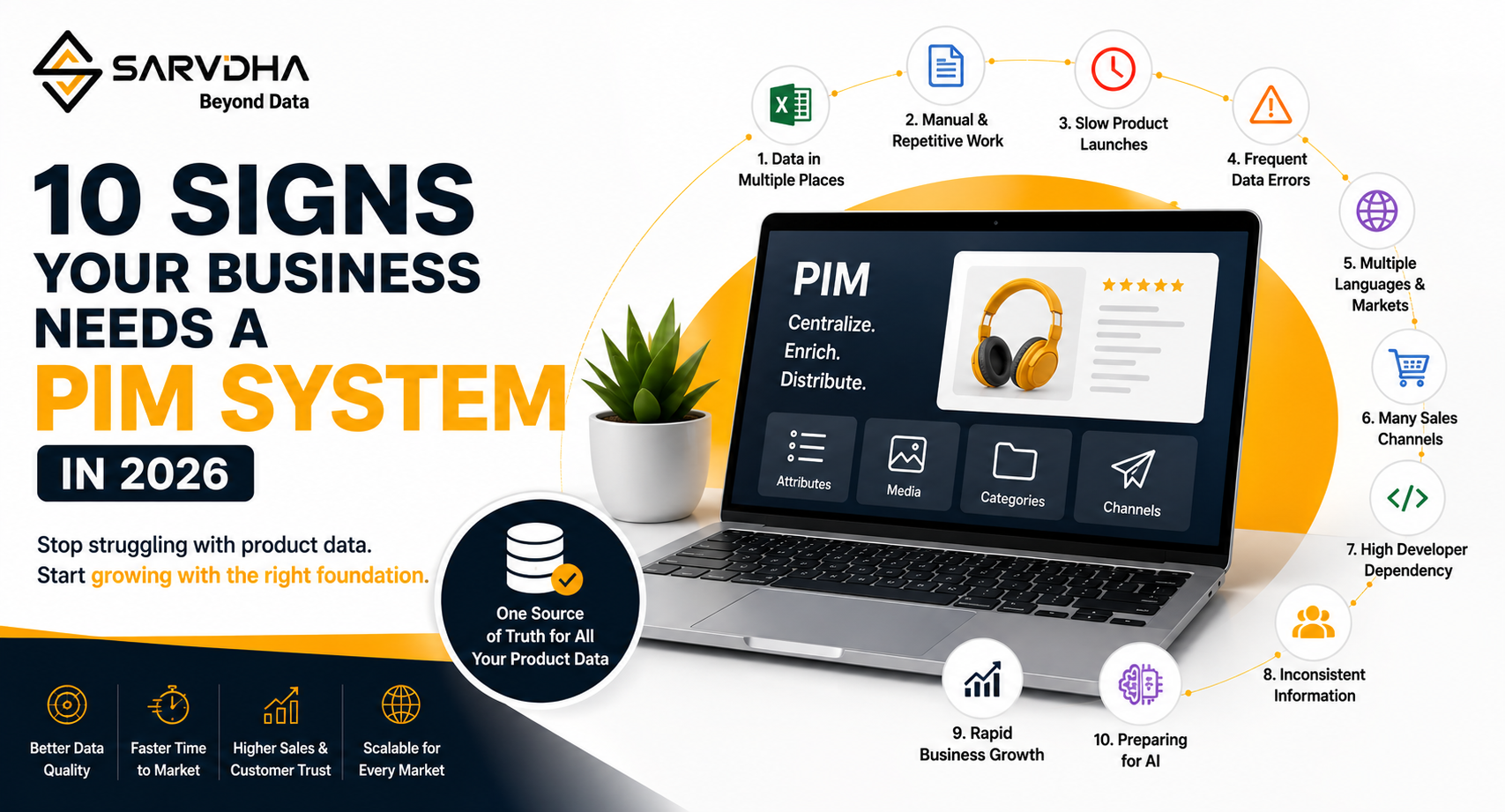
For an enterprise e-commerce business, PIM implementation can affect product data, ERP systems, suppliers, websites, marketplaces, digital assets, workflows, localization, integrations, and customer experience.
A successful PIM implementation therefore requires more than choosing a platform.
It requires a clear strategy.
Businesses need to understand:
- What product data they currently have
- Where that data comes from
- Which data is trusted
- Which attributes are required
- How products should be structured
- Who owns the data
- Which systems need to integrate
- Which markets need localization
- Which channels need product information
- How data will be validated
- How the solution will scale
The goal is not simply to implement PIM.
The goal is to create a reliable product data foundation that can support business growth.
What Is PIM Implementation?
PIM implementation is the process of designing, configuring, integrating, testing, and launching a Product Information Management solution within an organization.
A typical PIM implementation connects multiple sources and destinations.
A PIM becomes the central layer for managing product information before it is distributed to different channels.
Modern PIM platforms commonly bring together product data from ERP, PLM, supplier feeds and other sources, then support enrichment, governance and distribution to e-commerce and marketplace channels.
Why Do Businesses Need PIM Implementation?
As an organization grows, product information becomes increasingly difficult to manage.
A small company may have:
500 products
1 website
1 country
1 language
A growing enterprise might have:
50,000+ products
Multiple websites
Multiple countries
Multiple languages
Multiple marketplaces
Multiple suppliers
Multiple internal teams
The complexity grows quickly.
Without a centralized product information strategy, businesses often experience:
- Duplicate product information
- Inconsistent descriptions
- Missing attributes
- Outdated specifications
- Manual data entry
- Slow product launches
- Spreadsheet dependency
- Marketplace errors
- Poor search experiences
- Difficult localization
- Data quality problems
This is where PIM can become a strategic business capability rather than simply another software system.
When Should You Implement PIM?
There is no single product-count threshold at which every company needs PIM.
However, several signs indicate that your current approach may no longer scale.
1. Your Product Catalog Is Growing
Managing hundreds of products manually may be possible.
Managing tens of thousands becomes significantly harder.
2. You Sell Through Multiple Channels
For example:
- E-commerce website
- Amazon
- Regional marketplaces
- Distributors
- Mobile apps
- Retail partners
- Print catalogs
Each channel may require different product information.
3. You Operate in Multiple Countries
International expansion introduces:
- Languages
- Currencies
- Market-specific attributes
- Localized descriptions
- Regional requirements
- Different channel requirements
4. Your Teams Depend on Spreadsheets
If product managers, marketing teams, sales teams and e-commerce teams maintain separate spreadsheets, you probably have a product data governance problem.
5. Product Launches Take Too Long
If launching a new product requires manually updating multiple systems and channels, PIM can help create a more controlled workflow.
6. Your Product Data Is Inconsistent
If the same product has different names, specifications, descriptions or attributes across channels, you need stronger product data governance.
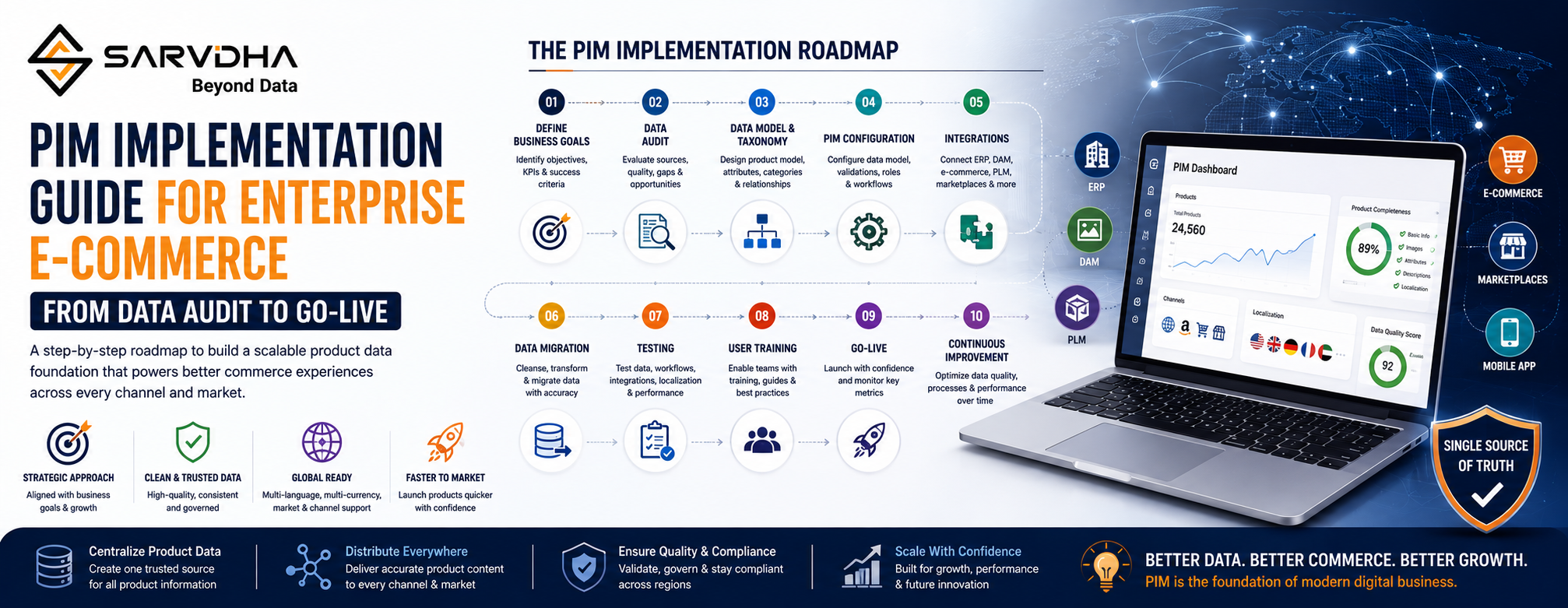
PIM Implementation: The 10-Step Process
A successful enterprise PIM implementation can be broken into several phases.
Step 1: Define Business Goals
Before selecting or configuring a PIM platform, define what the organization wants to achieve.
Do not start with:
"Which PIM features do we need?"
Start with:
"What business problem are we trying to solve?"
Possible objectives include:
- Reduce product onboarding time
- Improve product data quality
- Expand into new countries
- Reduce spreadsheet usage
- Improve marketplace publishing
- Improve search and filtering
- Reduce manual work
- Improve product experience
- Prepare for AI
- Support regulatory requirements
For example:
"We want to reduce the time required to launch a new product across five markets from two weeks to two days."
That's a measurable business objective.
Step 2: Conduct a Product Data Audit
This is one of the most important stages of PIM implementation.
Before moving data into a PIM, understand what you already have.
Identify:
- Product sources
- Product types
- Attributes
- Categories
- Product relationships
- Digital assets
- Languages
- Countries
- Suppliers
- Data owners
- Data quality problems
- Duplicate records
- Missing information
The audit tells you where your product data actually comes from.
Step 3: Define Your Product Data Model
A PIM is only as good as the data model behind it.
Your product model should define:
- Product types
- Attributes
- Attribute groups
- Categories
- Families
- Variants
- Relationships
- Units
- Localized fields
- Market-specific fields
- Channel-specific fields
For example, a laptop might have:
Basic Information
- Product Name
- SKU
- Brand
- Product Type
Technical Information
- Processor
- RAM
- Storage
- Screen Size
- Battery
Marketing Information
- Short Description
- Long Description
- Features
- Benefits
Digital Assets
- Main Image
- Gallery Images
- Product Video
- User Manual
A well-designed data model prevents product information from becoming a collection of unstructured fields.
Step 4: Build Your Taxonomy
Taxonomy defines how products are organized.
A strong taxonomy helps with:
- Navigation
- Product discovery
- Search
- Filtering
- SEO
- Marketplace mapping
- Reporting
- Product management
Taxonomy should therefore be treated as a business decision, not simply a technical configuration.
Step 5: Define Data Quality Rules
Before products reach customers, they should pass validation.
Examples:
Required fields
Product Name
SKU
Brand
Category
Main Image
Conditional fields
If product type = Laptop:
Processor required
RAM required
Storage required
Validation
Weight must be numeric.
Screen size must use an approved unit.
SKU must be unique.
Product status must be valid.
This prevents incomplete or incorrect information from reaching customer-facing channels.
Step 6: Design PIM Workflows
PIM should not only store data.
It should control how product information moves through the organization.
A typical workflow could be:
Different organizations may have different workflows.
A manufacturer may require technical approval.
A pharmaceutical business may require additional compliance processes.
A fashion retailer may require merchandising and marketing approval.
The workflow should reflect the business.
Step 7: Integrate PIM With Existing Systems
PIM rarely operates alone.
A typical enterprise environment may include:
- ERP
- CRM
- PLM
- DAM
- E-commerce platform
- Marketplace
- Supplier systems
- MDM
- Search platform
- Data warehouse
- Translation systems
The PIM architecture should define what information comes from each system.
For example:
ERP
SKU
Inventory
Pricing
Supplier references
PLM
Technical specifications
Components
Product development information
DAM
Images
Videos
Documents
PIM
Product descriptions
Attributes
Taxonomy
Marketing content
Channel content
This avoids creating unnecessary duplication between systems.
Step 8: Plan Localization
If your business operates internationally, localization should be considered from the beginning.
For example:
🇺🇸 United States
USD + English
🇬🇧 United Kingdom
GBP + English
🇩🇪 Germany
EUR + German
🇫🇷 France
EUR + French
🇦🇪 UAE
AED + localized market requirements
Localization may include:
- Language
- Currency
- Measurements
- Product descriptions
- Attributes
- SEO content
- Images
- Market availability
- Regulatory information
The architecture should allow new markets to be added without rebuilding the entire product model.
Step 9: Test Before Go-Live
Never move directly from configuration to production.
Testing should happen at multiple levels.
Data Testing
Are products imported correctly?
Integration Testing
Are ERP and PIM exchanging data correctly?
Workflow Testing
Are approvals working correctly?
Localization Testing
Are translated fields mapped correctly?
Channel Testing
Does the correct product information reach every channel?
Performance Testing
Can the system handle the expected catalog size and traffic?
User Acceptance Testing
Can business users actually perform their daily tasks?
Step 10: Go-Live and Continuous Improvement
Go-live is not the end of PIM implementation.
It is the beginning of ongoing product data management.
After launch, monitor:
- Data quality
- User adoption
- Product onboarding time
- Publishing errors
- Integration failures
- Workflow bottlenecks
- Search performance
- Product completeness
- Channel performance
Then continuously improve the system.
PIM Implementation Timeline
Every organization is different, so there is no universal implementation timeline.
A small implementation may be relatively quick.
An enterprise implementation involving:
- Multiple countries
- Multiple languages
- Complex ERP integration
- Multiple marketplaces
- Large product catalogs
- Multiple business units
can require significantly more planning.
A typical phased approach could look like:
The exact timeline should be determined by scope rather than an arbitrary number of weeks.
Data Migration: The Most Underestimated Part of PIM
One of the biggest mistakes businesses make is assuming:
"We will simply import our existing product data into PIM."
Existing data is rarely clean enough for that.
You may discover:
- Duplicate SKUs
- Missing descriptions
- Incorrect units
- Different attribute names
- Old products
- Incorrect categories
- Missing images
- Inconsistent naming
- Different formats between suppliers
Data migration should therefore include:
Extract → Clean → Transform → Validate → Import → Verify
PIM and AI Readiness
PIM implementation is becoming even more important as businesses adopt AI.
AI-powered applications need structured and trustworthy product information.
For example, AI-powered product search may need to understand:
- Product attributes
- Product categories
- Product relationships
- Availability
- Specifications
- Use cases
- Compatibility
If the underlying information is incomplete, AI may produce poor results.
This is why PIM should be considered part of an organization's broader AI data foundation.
PIM and Digital Product Passports
For businesses selling applicable products in the European Union, product information requirements are also evolving.
The EU Digital Product Passport framework is being introduced progressively under the Ecodesign for Sustainable Products Regulation.
The European Commission launched the DPP Registry and testing environment in July 2026. The framework is intended to support reliable and interoperable product information, while requirements will be introduced progressively for different product groups.
For applicable businesses, product information may need to support areas such as:
- Product identification
- Materials
- Composition
- Sustainability information
- Repairability
- Recycling
- Safety
- Compliance
- Product lifecycle information
The exact requirements depend on the product category and applicable legislation.
This makes a structured product data architecture increasingly valuable for organizations selling into European markets.
Common PIM Implementation Mistakes
Mistake 1: Choosing Software Before Understanding the Problem
A platform should support your business requirements.
Not the other way around.
Mistake 2: Migrating Dirty Data
Moving poor-quality data into a new platform does not solve the data quality problem.
It simply creates a more expensive place to store bad data.
Mistake 3: Ignoring Business Users
PIM is used by people.
Product managers, marketers, e-commerce teams, data teams, and other users should be involved in the design.
Mistake 4: Treating PIM as an Isolated System
PIM needs to work with the broader enterprise architecture.
Mistake 5: Ignoring Localization
If international expansion is part of the roadmap, localization should be included from the beginning.
Mistake 6: Building Too Much at Once
Trying to implement every feature, every country, and every integration simultaneously can increase risk.
A phased implementation is often easier to control.
Start With an MVP
A practical enterprise approach is to start with a controlled scope.
For example:
Phase 1
1 Product category
1 Country
1 E-commerce channel
1 ERP integration
Then expand:
Phase 2
Additional categories
Additional markets
Additional languages
Additional channels
Phase 3
Marketplace syndication
Advanced workflows
AI capabilities
Additional enterprise integrations
This approach allows teams to learn from the first implementation before scaling.
How to Measure PIM Success
A PIM implementation should have measurable outcomes.
Useful KPIs include:
Product Onboarding Time
How long does it take to create and publish a new product?
Data Completeness
What percentage of required product fields are complete?
Data Accuracy
How many product data errors reach customers?
Time to Market
How quickly can a product be launched across markets?
Channel Publishing Time
How long does it take to distribute updated product information?
Manual Work
How many hours are spent manually maintaining product information?
User Adoption
Are business teams actually using the PIM?
Product Data Quality
How many records require correction?
The goal is not simply to say:
"We implemented PIM."
The goal is to demonstrate:
"PIM improved the way our business manages and distributes product information."
Enterprise PIM Implementation Checklist
Before going live, ask:
Business
✓ Are business objectives defined?
✓ Are success KPIs defined?
✓ Are key stakeholders involved?
Data
✓ Has the product data been audited?
✓ Are duplicates removed?
✓ Is the taxonomy defined?
✓ Is the product model approved?
✓ Are data quality rules defined?
Technology
✓ Are ERP integrations designed?
✓ Are DAM integrations defined?
✓ Are e-commerce integrations ready?
✓ Are marketplace integrations planned?
✓ Are APIs documented?
Operations
✓ Are workflows defined?
✓ Are user roles defined?
✓ Are approval processes documented?
✓ Is user training complete?
International
✓ Are multiple languages supported?
✓ Are currencies supported?
✓ Are market-specific attributes supported?
✓ Is localization workflow defined?
AI
✓ Is product data structured?
✓ Are attributes standardized?
✓ Is product data accessible through APIs?
✓ Can the data support AI search and recommendations?
Go-Live
✓ Has migration been tested?
✓ Has UAT been completed?
✓ Are integration failures monitored?
✓ Is a rollback plan available?
PIM Implementation for Global E-commerce
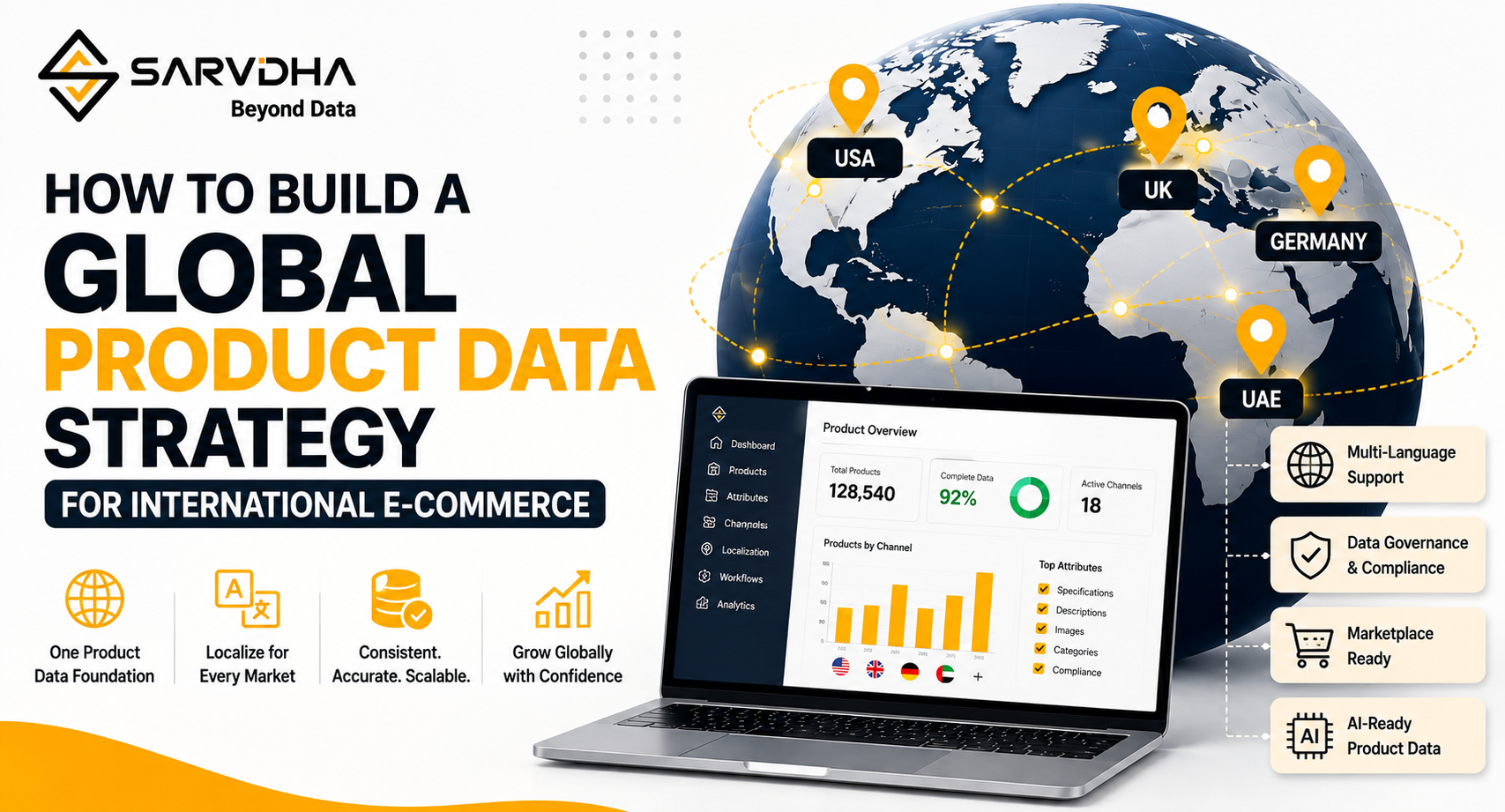
For organizations selling across the US, UK, Europe, UAE and other international markets, PIM implementation should be designed with global scalability in mind.
The architecture should allow businesses to maintain:
One core product
while supporting:
Multiple markets
Multiple languages
Multiple currencies
Multiple channels
Multiple customer experiences
This is one of the biggest advantages of designing the product data model correctly from the beginning.
How Sarvdha Helps With PIM Implementation
At Sarvdha, we help businesses design and implement scalable product information solutions.
Our approach can cover:
- Business discovery
- Product data audits
- PIM architecture
- Data modeling
- Taxonomy design
- Product data migration
- ERP integration
- DAM integration
- E-commerce integration
- Marketplace integration
- Localization
- Workflow design
- Data governance
- AI-ready product data
- Custom PIM development
- Enterprise application integration
The objective is not simply to deploy a PIM platform.
The objective is to build a product data foundation that supports your business today and scales with your future growth.
Conclusion
A successful PIM implementation is a business transformation project—not simply a software installation.
The most successful implementations start with understanding the business problem, auditing existing product data, designing the right product model, establishing governance, integrating enterprise systems, and involving business users throughout the process.
For global e-commerce businesses, the importance becomes even greater.
Your product data needs to support:
- Multiple countries
- Multiple languages
- Multiple currencies
- Multiple channels
- AI-powered experiences
- Evolving product information requirements
The right PIM architecture can help turn fragmented product information into a structured and scalable business asset.
The question is not:
"Which PIM should we buy?"
The better question is:
"What product data foundation does our business need to scale?"
Because the right PIM implementation doesn't just organize product data.
It creates the foundation for better commerce, better customer experiences, and sustainable global growth.
Frequently Asked Questions
What is PIM implementation?
PIM implementation is the process of designing, configuring, integrating, testing, migrating data into, and launching a Product Information Management solution.
How long does PIM implementation take?
There is no universal timeline. The duration depends on catalog size, number of countries, languages, integrations, workflows, data quality, and business complexity.
What systems integrate with PIM?
PIM can integrate with systems such as ERP, PLM, DAM, MDM, e-commerce platforms, marketplaces, supplier systems, search platforms and data services.
Should we clean our data before implementing PIM?
Yes. A data audit and cleansing process should normally happen before large-scale migration. Moving poor-quality data into PIM does not solve the underlying problem.
Can PIM support multiple countries?
Yes. A properly designed PIM can support localized product information, languages, currencies, market-specific attributes and channel requirements.
Is PIM useful for AI?
Yes. Structured and governed product information can provide a stronger foundation for AI-powered search, recommendations, categorization, content generation and conversational commerce.
Is PIM the same as MDM?
No. PIM primarily focuses on product information, while MDM provides broader governance and management of master data across entities such as products, customers, suppliers and locations.
Does PIM replace ERP?
No. PIM and ERP generally serve different purposes and often work together. ERP typically manages operational and transactional processes, while PIM manages product information for commerce and distribution.